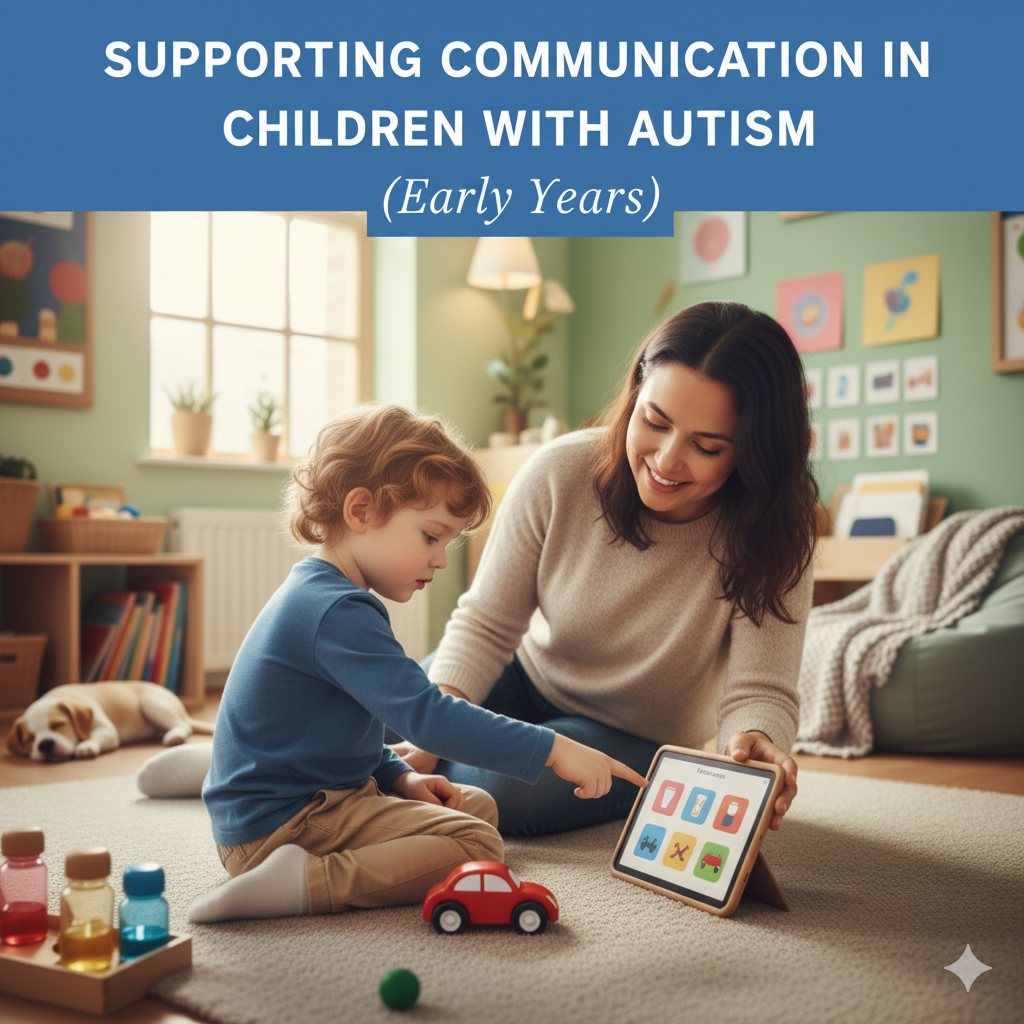
Supporting Communication in Children with Autism (Early Years)
Parents play the biggest role in helping autistic children communicate. The most effective supports in Australia are family-centred, strengths-based, and delivered in everyday routines with coaching for caregivers. This guide distils best-practice recommendations and evidence, with simple steps you can start today.
What can work best
- Family- and child-centred supports: goals are meaningful to your child and family, and supports are acceptable, safe, and effective.
Why this matters: Australia’s National Guideline emphasises supports that are desirable to families, evidence-informed, and delivered in natural settings. - Parent-mediated approaches: your clinician coaches you to use strategies during play, mealtimes, getting dressed, and outings.
- Measure and adapt: track a few clear goals, review progress frequently, and adjust intensity and methods.
Set up a communication-rich home
- Reduce background noise during talking time; sit face-to-face at your child’s level.
- Follow your child’s lead: talk about what they are looking at or doing; copy their sounds or actions to start turns.
- Use short models: 1–4 words that match their level (e.g., “open,” “big car,” “more bubbles”).
- Pause and wait: count to five in your head to give space for attempts.
- Expand their communication: child says “car” → you say “red car” or “car go!”.
Visual supports: make language easier to understand
Many autistic children process visual information more easily than speech. Use visuals to show the plan and reduce stress:
- Choice boards for snacks, toys, activities.
- First–Then boards (e.g., “First teeth, then book”).
- Mini schedules for tricky routines like getting dressed or leaving the park.
- Timers or sand timers to signal “how long”.
Start with photos from your phone or simple drawings. Keep them in the same spot and use the same words each time.
AAC early and confidently
Augmentative and Alternative Communication (AAC) includes signs, picture boards (e.g., PODD-style books), and speech-generating apps. AAC:
- Does not delay speech. Research shows AAC often increases speech while giving an immediate way to communicate.
- Reduces frustration and behaviours driven by unmet communication needs.
- Works best when adults model the system during everyday activities.
Ask your speech pathologist to trial AAC options and teach simple “core” words first (e.g., more, help, go, stop, finished, open, turn, like).
Create daily “communication opportunities”
- Offer choices instead of guessing: “Do you want apple or yoghurt?”
- Give small portions so your child can request “more”.
- Put favourites in sight but out of reach to encourage asking for help.
- Pause during predictable routines (songs, tickles, swinging) to invite a look, sound, gesture, sign, or AAC press.
Teach replacement communication for tricky moments (FCT)
Functional Communication Training (FCT) replaces challenging behaviours with simple, effective communication. Identify the need first, then teach a quick way to ask:
- Escape/overload → “break” or a break button.
- Tangible/request → “more”, “open”, name of the item.
- Attention → “look”, “my turn”, name + gesture.
Model the new message, prompt it once if needed, and reinforce it immediately. Use signs, pictures, or AAC if speech is hard in the moment.
Build joint attention and play
- Share the focus: point to interesting things, wait for a look, then comment (“Wow, bubbles up!”).
- Enjoy turn-taking games: blocks, rolling balls, tickle–pause–tickle.
- Match interests: if vehicles are a favourite, play “ready–set–GO”, label actions (push, stop, crash), and expand to simple pretend.
Understanding language: make it concrete
- Give one step at a time, then build to two steps in familiar routines.
- Show + say (gesture, point, picture) and use consistent words.
- Teach everyday concepts in context: in/on/under, big/small, fast/slow.
Regulation comes first
Communication improves when children are calm and organised. Use predictable routines, visual plans, movement breaks, and a quiet space when overwhelmed. Collaborate with OT for sensory strategies where needed.
Programs and pathways you might hear about
- Parent-mediated coaching approaches delivered by speech pathologists (e.g., video-feedback models such as PACT) help parents tune in, slow down, and respond to their child’s communication signals.
- Naturalistic developmental behavioural interventions (NDBI) embed teaching in play and daily routines, using child interests and positive reinforcement.
- AAC assessment and trials are appropriate at any age when speech isn’t meeting needs.
Note: No single program suits all children. Your plan should reflect your child’s profile, family priorities, and the evidence base.
When to seek extra help
- Very limited communication attempts or few ways to get needs met.
- Frequent distress linked to communication breakdown.
- Loss of skills at any age.
- Hearing concerns—ask your GP for an audiology check.
Useful Australian resources
- National Guideline for supporting autistic children and families (Autism CRC) — best practice overview and recommendations.
- Raising Children Network — parent-friendly guides on visual supports, AAC, and FCT.
- Speech Pathology Australia — AAC information and finding a certified speech pathologist.
About the author
Nikkita Wallace — Senior Speech Pathologist with 15 years’ experience supporting Brisbane children with complex communication needs across the NDIS, public sector, hospitals, schools, and Medicare.
Need guidance for your child or an AAC/FCT plan? Call 0432 309 882 or email admin@leaptherapy.com.au.
References (APA 7th)
- Autism CRC. (2023). National Guideline for supporting the learning, participation, and wellbeing of autistic children and their families in Australia. https://www.autismcrc.com.au/best-practice/supporting-children
- Autism CRC. (2023). About the Guideline. https://www.autismcrc.com.au/best-practice/supporting-children/guideline
- Raising Children Network. (2024, May 14). Augmentative and alternative communication (AAC) & autism. https://raisingchildren.net.au/autism/development/language-development/augmentative-communication-asd
- Raising Children Network. (2024, May 31). Visual supports. https://raisingchildren.net.au/autism/therapies-guide/visual-supports
- Raising Children Network. (2024, July 2). Functional Communication Training (FCT). https://raisingchildren.net.au/autism/therapies-guide/fct
- Speech Pathology Australia. (2024). Augmentative and Alternative Communication. https://www.speechpathologyaustralia.org.au/.../Augmentative-Alternative-Communication.aspx
- Oono, I. P., Honey, E. J., & McConachie, H. (2013). Parent-mediated early intervention for young children with autism spectrum disorders (ASD). Cochrane Database of Systematic Reviews, (4), CD009774. https://www.cochranelibrary.com/.../CD009774
- Tiger, J. H., Hanley, G. P., & Bruzek, J. (2008). Functional communication training: A review and practical guide. Behavior Analysis in Practice, 1(1), 16–23. https://pmc.ncbi.nlm.nih.gov/articles/PMC2846575/
- Schlosser, R. W., & Wendt, O. (2008). Effects of augmentative and alternative communication intervention on speech production: A meta-analysis. American Journal of Speech-Language Pathology, 17(3), 212–230. https://pubmed.ncbi.nlm.nih.gov/18663107/
- Millar, D. C., Light, J. C., & Schlosser, R. W. (2006). The impact of AAC intervention on the speech production of individuals with developmental disabilities: A meta-analysis. Journal of Speech, Language, and Hearing Research, 49(2), 248–264. https://pubmed.ncbi.nlm.nih.gov/16671842/